Sweet Tooth Alert!
There are many culinary delights in Portugal's amazing cuisine, with a wide variety of dishes, ranging from meats, fish, seafood, and vegetables. The Portuguese use olive oil as the start and finishing garnish to all of their dishes, showcasing a distinguished home cooking style with balanced spices that are utterly delicious.
The flood of diverse tastes that can fill your mouth is also present in the baked goods. Portugal, much like all of Europe, loves a good pastry - with or without coffee, bring on the pastries, we say.
Portuguese Pastries: History & Tradition
The Portuguese obsession with sweets, pastries and cakes began in the 15th century during the Age of Discovery, which also connects to how each discovered land corresponds with our ingredient use.
For example, by discovering Madeira island in 1418 at Porto Santo, Henrique of Portugal (Henry the Navigator) urged the plantation of sugarcane crops, which became a great success, giving Portugal a taste of sugar.
Later, the discovery of Brazil in 1500 was a pivotal point in the further production of sugar, and economic gain for the Portuguese Empire - thus our fixation with sugar began.
The Portuguese also hold much love for other well-devoured desserts that are a staple at any loving grandmother's home, and local restaurant.
We want to show you the must-try sweet sensations from Portugal; we promise that there will be a favorite for everyone.

Portuguese Pastries List
1. Pastel de Nata
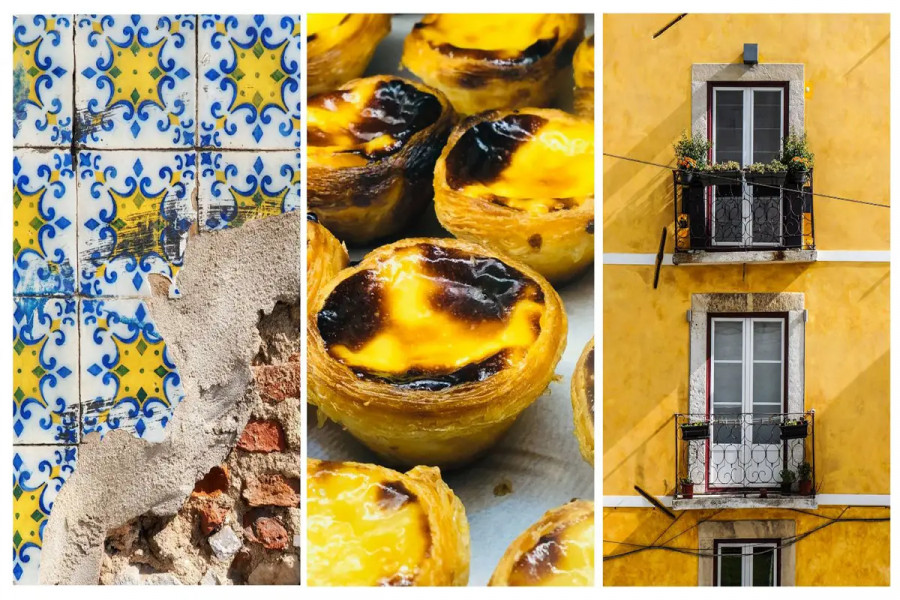
Portugal's more famous for its Pastel de Nata, a buttery vanilla custard tart with flaky puff pastry that melts in your mouth!
You can find it in any street corner café; but we always say go to the source at Pastéis de Belém, having been baking these delicious tarts since 1837 at their factory, and pastry café situated in Belém's heart.
The secret recipe was originally regenerated by monks at the Mosteiro dos Jerónimos, and recreated using traditional methods, which keep the sweet tooth of locals and tourists satisfied.

Pastéis de Nata: the ultimate staple of Portuguese pastries.
2. Pão de Ló
The history behind the Pão de Ló or Pão de Castela dates back to the 1700s when a Genovian chef sent by Spain in a banquet presented the King of Spain with Pan di Spagna, which later was adapted by the neighbouring Portuguese.
There are also links to the Age of Discovery when travels were made to Japan, that the recipe was evolved further and inspired by the famous Japanese cake Kasutera.
There are various variations of this cake, we have the Pão de Ló de Ovar which is considered to be gooey and moist, since it has a total of 18 egg yolks, and six whole eggs made in an old fashioned clay pot.
The traditional Pão de Ló is a sponge bread, made with eggs, flour and sugar; a principal dessert for Christmas and Easter celebrations, however, we think this tasty sponge cake goes particularly well with coffee or tea sessions.
3. Ovos Moles
As you can notice, the Portuguese absolutely love eggs, and Ovos Moles are a pure representation of that. These sweet treats originated around 1501, in the Convento de Jesus de Aveiro, a convent in the centre region of Portugal, Aveiro.
I'ss known by the Portuguese that egg whites were typically used for domestic purposes, such as ironing clothes - while the yolks were often discarded, and not sure on what to do with them - until the day it was decided to add sugar to the yolks.
Nuns at the Convento de Jesus de Aveiro created this sweet egg dessert, which was served at daily mass as the bread of Christ.
4. Travesseiros de Sintra
The famous Travesseiros de Sintra, (travesseiros loosely translatetes to “pillows”) - which is literally what these flaky sweet pastries of egg cream and almonds look like.
The history behind these dreamy “pillows” comes from a local bakery in Sintra, a charming town within the cool mountain range of the Serra de Sintra.
The bakery under the name “Casa Piriquita” was originally given by King D. Carlos I, as he named the bakery after the wife’s owner, being a woman of very small stature.
The King encouraged the bakery owners to confection sweets, such as the other well-known Sintra specialty - Queijadas de Sintra, which became a huge success and widely popular.
Later, the couple's then daughter found an old recipe book with the recipe for travesseiros, and this original recipe has been kept secret and loved by all who try these delicious Travesseiros de Sintra.
5. Bola de Berlim
The famous Bola de Berlim, a delicious deep-fried, egg custard-filled donut - a staple must-have at every beach, where street vendors serve freshly made during the summer months. The real history behind the doughy delight came from the second world war as numerous Jews escaped for Germany and sought asylum in Portugal.
The refugees began working in cafes, and bakeries, meanwhile introducing the Portuguese to Germanic pastries such as the Berlinesa or Berliner - thus the Portuguese name Bola de Berlim.
Nowadays, you will find many more flavours of the Bola de Berlim from caramel, cinnamon apple, Belgian chocolate, chocolate, and praline, and with or without your traditional egg custard.
6. Pastel de Feijão
The adored Pastel de Feijão, a hearty navy bean jam-filled pastry with a crispy tart dough, a recipe from the 19th century; originally introduced by a local at the village of Torres Vedras, near Lisbon.
These treats became so popular that they were daily delivered to Lisbon by train, and made available at various pastry shops; one of them being, Confeitaria Nacional at Praça da Figueira in Lisbon, which is one of the oldest pastry shops, serving sugary delights for almost 200 years.
The recipe was passed down through generations, where it became highly confectioned in its original almond, and bean flavor. It may seem crazy to make pastries with beans, but trust us - it's so tasty, you wouldn't even know it’s beans.
7. Queijadas de Sintra
The history behind de Queijadas de Sintra dates back to the 19th century, originally the recipe was created in the village of Ranholas in Sintra, and this sweet treat was formerly known as a form of exchange for fees.
There are transcripts written by famous Portuguese writer Eça de Queirós, describing a recommendation between a mother and son to go for a walk around Sintra, but not to forget the Queijadas as a payment for the month's rent.
The traditional Queijada de Sintra is made of fresh cheese, sugar, eggs, flour and a dash of cinnamon, placed in a crunchy dough.
There are many variations nowadays of this pastry, however, we always say stick to the original recipe that can be tasted at many local cafés, which will have the local delights.
8. Patas de Veado
The Portuguese dessert, Patas de Veado, is beautifully crafted to look like a deer's foot, thus the literal translation “Deer’s Foot” - consist of a swiss roll filled with egg custard, sliced diagonally, coated with egg custard, coconut flakes, and a thin design of ground cinnamon to resemble a hoof.
We suggest seeing this aesthetically pleasing dessert anywhere in the coastal lagoon city of Aveiro; locals and tourists alike review the Patas de Veado at this bakery and pastry shop as hands down the best.
9. Bolo de Arroz
If you have ever ventured to Portugal, we are positive that you have seen this little cake with a wrapper announcing itself as Bolo de Arroz - a muffin look-a-like of sorts, however, we are biased to say that it tastes much better than any muffin.
The lovely Bolo de Arroz is traditionally made with rice flour, making the dough's texture light, fluffy, and soft, perfect for a tea and coffee break.
The real origin of the Bolo de Arroz is unclear; there is only a recipe book from 1933, named the Ideal Kitchen by Chef Manuel Ferreira, who refers to the Bolo de Arroz as a simple delight, that is not overly greasy and is completely different from a traditional queque.
10. Toucinho do Céu
A staple Portuguese dessert in which the recipe was originally crafted by nuns in a convent, it's said the nuns used pork fat instead of butter to make this dessert.
However, the buttery delight of Toucinho do Céu which translated means a “Bacon of Heaven” is always served with the main ingredients like sugar, flour, egg yolks, almond flour, and almonds.
11. Queque
The little Queque, a rather simple muffin of sorts that is adored for its buttery taste! The Queque is seen in almost every street café, a variation of the recipe can be found with walnuts.
It is very similar to the Pão de Ló, but more compact and made with butter, eggs, and sugar.
Enjoy this buttery delight with a cup of tea or coffee, we are positive you'll love it.
12. Fatia Dourada or Rabanada
Let us introduce you to Fatia Dourada or Rabanada - the Portuguese version of French toast.
The Fatia Dourada, literally translated as the “Golden Slice” or Rabanada, unlike the American-style French Toast, the Portuguese Rabanada are crispier, as they are made of crusty bread, soaked in eggs, milk, and cinnamon, fried and dusted with sugar and cinnamon.
Another version of Rabanadas in Northern Portugal, Minho, is made with wine, either red wine, wine, or green, equally delicious.
The history behind the Fatia Dourada dates back to the 11th century when the recipe was originally made with leftover stale bread, eggs, and honey.
This little dessert was eaten during Easter as the Portuguese avoided consuming meat, and in turn, delighted themselves with the “Golden Slice”.
Nowadays, it has become a traditional staple at every Christmas dinner table for dessert or Christmas morning breakfast.
13. Fradinho
The Fradinho is less commonly known by tourists, but nonetheless a historic conventional sweet typical of Portugal.
The origin of this little pastry is all thanks to a local bakery shop in Mafra, by the same name as the sweet itself.
The Fradinho is made of beans, sweet egg cream, and almonds; much like the Pastel de Feijão; the sweet-tart is filled with sweet bean jam, and it is absolutely fantastic with a good cup of espresso, or a bica, as the Portuguese say.
14. Jesuítas
The Jesuíta pastry is a delicious pastry made of filo dough and sugar and traditionally made by real Jesuits from Santo Tirso near Porto. The history behind the sweet treat is closely linked to the Christian faith, as the name Jesuítas is derived from Jesus. Locals say that the recipe of the sweet was brought to Portugal from Spain by a Spanish pastry chef who was working in a Jesuit Community in Bilbao, and ever since the pastry became a staple must-have sweet for the Portuguese.
15. Pão de Deus
Pão de Deus is a pastry that has a connection with a holiday in Portugal, called the Dia de Todos Os Santos (All Saints' Day) held on November 1, where it was traditional for children to beg for this sweet as “Pão de Deus”, meaning “ the Bread of God”.
The tradition was that, on this day, all the noblemen would set a table with food and drink for the poor.
Nowadays, this tradition is not in practice but the sweet cake of soft brioche with sweet coconut crust remains to be adored, and surprisingly a staple for breakfast; as the Pão de Deus is usually eaten in the morning, and served with ham and cheese.
Read more:
Halloween in Portugal: How It’s Celebrated and What to Expect